What the October 12 cyberattack teaches any company about business continuity
By Dani Cruzado, CEO of Estratec360
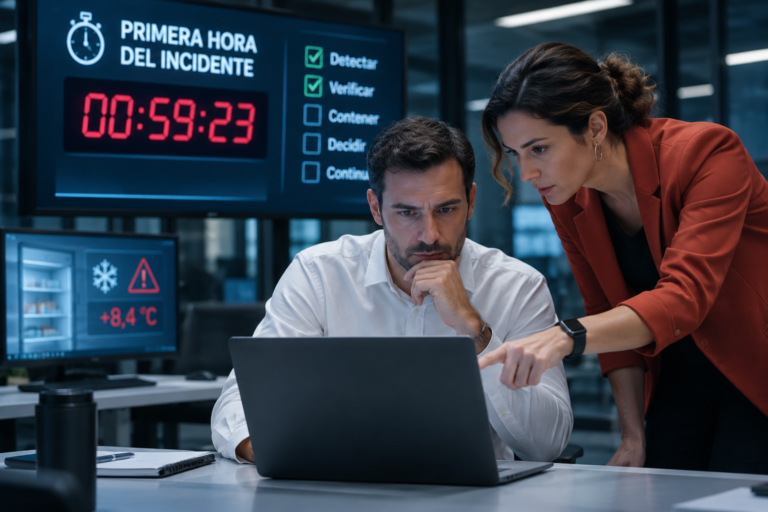
On Monday, October 12, first thing in the morning, employees at hundreds of French supermarkets found the refrigerators and freezers warm. Overnight, someone had taken remote control of the systems that regulate the cold and forced a continuous defrost cycle, with temperatures reaching up to 50°C. By the time the stores opened, much of the fresh and frozen produce could no longer be sold.
The French government estimates around 700 stores were affected, from chains such as Intermarché, Coopérative U, Carrefour, Leclerc, and Monoprix. No data was stolen and no server was encrypted. The attack went straight for what underpins a supermarket’s business: keeping what it sells from spoiling.
I bring up this case because it explains, better than any report could, something that’s hard to get across in a management meeting. A cybersecurity incident doesn’t stay a technical problem. It turns into merchandise sent to landfill, unfulfilled orders, and customers who shop somewhere else that morning.
What it exposed
Early reports point to Danfoss refrigeration controllers, a manufacturer present in a great many French stores. Security researchers had already published vulnerabilities in that platform back in August. The following night brought new incidents involving equipment from another manufacturer, and the Paris public prosecutor’s office is still investigating whether it all traces back to the same source.
One detail strikes me as especially telling: Intermarché has already warned that one of the thorniest issues will be insurance, since its policies don’t cover this type of incident. The loss, then, falls on the business itself.
Every company has its own “cold chain”
In a supermarket, it’s the cold chain. In a distributor, it might be the warehouse management software; in a factory, the system that issues commands to a production line; in a professional practice, the server holding the file that has to be submitted tomorrow.
Companies usually know in great detail what they sell, and considerably less about what they need in order to sell it. A simple exercise I always recommend: take a real order and follow it from the moment it comes in until it gets paid. At every step, ask what’s needed (a system, a person, a supplier) and what you’d do if it weren’t available tomorrow. This brings to light dependencies no one had on their radar, because each department only watches its own stretch of the process: an old application still doing a key task, a single piece of equipment that invoicing depends on, or a supplier with just one technician who knows the installation.
How long can your business afford to stop?
Not every stoppage costs the same. An hour without email is an annoyance. An hour without refrigeration, in a supermarket, can decide whether the stock is saved or thrown out.
That’s what a business impact analysis is for: knowing what happens when each process stops, how the damage grows hour by hour, and what needs to be recovered first. That’s where the figure comes from that should guide any investment in recovery: the maximum amount of time each activity can be down. If restoring a system takes longer than the business can withstand, there are two paths left: shorten the recovery time, or set up a way to keep working while it lasts, even if it’s manual.
When the problem hits everyone at once
The scale of the attack raises a question very few plans account for: what happens when the incident isn’t just yours. That morning, hundreds of stores needed their refrigeration technicians all at the same time. It’s easy to picture the situation facing a maintenance provider with dozens of affected clients in those same hours.
The same goes for any critical supplier: IT support, spare parts, transport, or recovery services. Before signing off on a backup supplier, it’s worth knowing their real capacity, their response times, and what technology they depend on. If your primary and backup providers both run on the same platform, a failure there leaves you without either. In Belgium, in fact, it has already been pointed out that a large part of the cold chain depends on a single manufacturer.
What a continuity plan needs to resolve
A continuity plan is useful if, at six in the morning with half the team unreachable, someone knows exactly what to do. To that end, it must answer, at minimum, five questions:
- Which activities must be kept running and which can wait.
- Who decides and who acts, including outside regular hours.
- How we keep working while the problem is being resolved.
- What gets communicated, and when, to employees, customers, and suppliers.
- In what order activity is restored, and how we confirm we can resume it.
All of this has to be coordinated with the technical response. While IT contains the incident, someone has to keep handling orders, reorganize production, and answer to customers.
Testing it before you need it
Having backups and a disaster recovery plan doesn’t guarantee you’ll be back up and running on time. Having tested it does. And the test isn’t over when the server comes back online, but when people can get back to work—that’s not the same thing. That’s where the real problems surface: access held by only one person, an authorization that depends on someone who can’t be reached, or a restore that takes three times longer than expected. Finding this out in a drill is an inconvenience; finding it out with customers waiting costs a lot more.
A leadership decision
IT knows the technology; Operations knows the processes; Finance knows what every hour of downtime costs. But deciding which risks to accept and how much to invest in preparing for them is a leadership call. When it’s delegated as a purely technical matter, the plan usually ends up half-finished.
At Estratec360, we work right at that intersection between business continuity, data protection, and cybersecurity: what has to keep running, what could stop it, and how to recover it within the window the business can tolerate.
French supermarkets found out in the morning what had happened overnight. The question I leave with any leadership team is simple: if what underpins your business stopped tonight, who would find out first—and what would they do?
If you want to put your response plan to the test, here I explain what to do in the first hour of a cyberattack.
Let’s talk about how to prepare your company’s business continuity